Address
304 North Cardinal
St. Dorchester Center, MA 02124
Work Hours
Monday to Friday: 7AM - 7PM
Weekend: 10AM - 5PM
Address
304 North Cardinal
St. Dorchester Center, MA 02124
Work Hours
Monday to Friday: 7AM - 7PM
Weekend: 10AM - 5PM
Choosing the right USB-C hub begins with identifying the connections your laptop and peripherals actually require. Count the ports you use today, then allow room for future devices. A basic multiport adapter typically adds a few essentials, such as USB-A, HDMI, and an SD card slot, while a full-featured hub or docking station may provide several high-speed ports, multiple displays, Ethernet, audio, and laptop charging. The latter is better suited to a permanent desk setup, but it is usually larger and more expensive.
USB-C describes the connector’s shape, not its performance. One port may support USB 3.x data rates, while another supports USB4, DisplayPort Alt Mode, or Power Delivery. Check the advertised specifications rather than assuming two USB-C devices will work identically. USB 3.x is adequate for everyday accessories and many storage drives; USB4 is preferable for demanding file transfers and advanced docks. DisplayPort Alt Mode carries video through USB-C, while HDMI output determines the display resolution and refresh rates available. Power Delivery wattage also matters: a hub should support enough passthrough power to charge the laptop while connected peripherals are active.
Compatibility should be verified for Windows laptops, MacBooks, Chromebooks, tablets, and other USB-C devices. Some operating systems or hardware configurations limit multi-monitor support, and Mac models may handle external displays differently from Windows systems. Confirm support for your computer’s required video standard, charging level, and operating system before buying.
Build quality affects reliability, especially when a hub is frequently connected and disconnected. Look for a sturdy enclosure, a flexible but reinforced cable, effective heat management, and a warranty from a reputable manufacturer. Thermal performance is important because sustained transfers or video output can make compact hubs warm and may affect speed.
Match the design to your routine. Students and travelers often benefit from a lightweight adapter with essential ports. Office workers may need Ethernet, reliable Power Delivery, and one or more monitor outputs. Photographers should prioritize fast USB data connections and dependable SD or microSD readers. A compact model is convenient for travel, while a larger docking station is more appropriate for a fixed workstation.
The Anker 555 USB-C Hub is a strong all-purpose choice for travelers who need more than basic expansion. Its eight ports include two USB-A 3.0 ports, a 5Gbps USB-C data port, USB-C Power Delivery, HDMI, SD and microSD card readers, and Gigabit Ethernet. HDMI supports up to 4K at 60Hz on compatible Windows systems, although some Mac configurations are limited to 4K at 30Hz. Measuring roughly 4.9 by 2.2 by 0.7 inches and weighing about 6.7 ounces, it remains portable while providing useful desktop connectivity. The attached host cable stores neatly against the body, and compatibility extends across Windows, macOS, ChromeOS, and many USB-C tablets. It is best for photographers, office users, and travelers who need wired networking and card readers, though all connected devices share the hub’s bandwidth.

For lighter carry, the Satechi Aluminum Multi-Port Adapter V2 offers a slimmer, polished design and a permanently attached cable. It combines USB-A ports, HDMI, SD and microSD readers, Gigabit Ethernet, and USB-C charging passthrough in a compact body weighing approximately three ounces. Its USB 3.0 connection reaches up to 5Gbps, while HDMI generally supports 4K at 30Hz. The short cable is convenient with laptops but can be restrictive when ports are positioned awkwardly or a protective case is fitted. Broad Windows and macOS compatibility makes it essentially plug and play. This is a practical value option for adding legacy accessories, memory cards, and wired internet, but it is not intended for high-refresh displays or multiple monitors.

The UGREEN Revodok 6-in-1 is particularly easy to pack, with two USB-A 3.0 ports, HDMI, SD and microSD readers, and USB-C Power Delivery. It typically supports 4K at 30Hz and USB transfers up to 5Gbps, while charging passthrough can reach 100W before power consumed by the hub. Its compact enclosure and attached lead suit mobile work, but the absence of Ethernet makes it less versatile than the Anker or Satechi. It is ideal for users who prioritize storage cards, USB accessories, and a single external display over maximum desktop expansion.
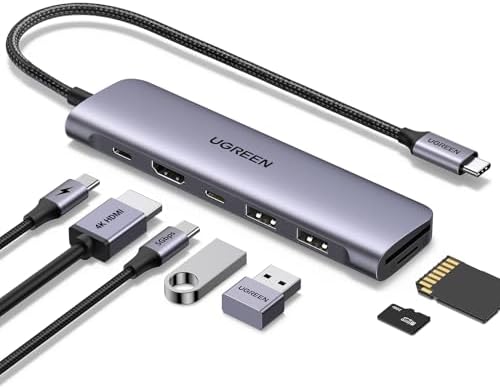
For a permanent desk setup, the CalDigit TS4 remains a strong premium choice. Its Thunderbolt 4 connection supports high-speed external SSDs, 2.5Gb Ethernet, SD and microSD cards, USB-A and USB-C accessories, audio, and substantial Power Delivery passthrough. It is best for Thunderbolt 4 or USB4 laptops that need one-monitor operation with fast storage and wired networking at the same time. A single display is straightforward; dual displays depend on the laptop’s native DisplayPort Alt Mode support, operating system, and display arrangement.

The Anker 778 Thunderbolt Docking Station suits creators and workstation users who need multiple display outputs. It provides HDMI and DisplayPort connectivity alongside high-speed USB ports, Ethernet, card readers, audio, and strong charging. It can drive two external monitors on compatible Windows laptops, while macOS support may restrict extended displays unless the computer supports the required configuration or DisplayLink technology. Users can generally combine one display, an SSD, Ethernet, and USB peripherals, although simultaneous transfers share the Thunderbolt link.

For a more affordable high-performance option, the Plugable UD-6950PDZ is particularly useful for office workers managing two monitors, keyboard, mouse, storage, and wired internet. Its DisplayLink architecture makes dual-monitor support practical on many Windows systems, but it requires drivers and may be less suitable for gaming, protected video, or systems with restricted software installation. It is a good match for USB-C laptops lacking native dual-display support, provided expectations about display compression and latency remain realistic.

The Kensington SD5780T is well suited to business users who prioritize dependable Thunderbolt connectivity, SD and microSD transfers, audio, Ethernet, and Power Delivery. It handles a monitor, external SSD, conference accessories, and wired networking without major compromises on compatible laptops. Across all choices, a high-speed SSD can approach its advertised rate only when other devices are not consuming the same controller bandwidth. Large photo or video transfers, multiple displays, gaming peripherals, and Ethernet may therefore compete for throughput, particularly through shared USB ports or lower-bandwidth laptop implementations. Check the laptop chipset, operating system, charging requirement, and native DisplayPort Alt Mode support before buying.

Across the ten models, the overall winner offers the strongest balance of price, portability, port variety, charging, display support, and sustained data performance. The premium desktop hub ranks closely behind, trading a higher price for broader connectivity and a better fit for permanent workstations. The third model is the best budget option: it covers essential USB expansion and display needs without paying for features many occasional users will not use. The fourth is the best compact travel hub, prioritizing a small footprint and low weight over maximum port count.
The fifth model is the best choice for MacBook users because its port layout and display behavior align well with macOS setups. The sixth is the best Windows productivity hub, combining practical expansion, charging support, and reliable peripheral connectivity. The seventh is the strongest option for creators and photographers, particularly where fast data transfers and dependable card-reader access matter. The eighth is the best model for multi-monitor desks, provided the laptop supports the required display protocol and output limits. The ninth is a balanced midrange alternative for mixed home and office use, while the tenth is the simplest choice for basic accessories and occasional travel.
Before buying, check this concise checklist: confirm connector compatibility and whether the laptop’s USB-C port supports data, charging, DisplayPort, or Thunderbolt; verify required wattage and pass-through limits; match monitor resolution and refresh rate; check Ethernet speed; confirm card-reader support; review performance when several ports operate simultaneously; inspect the return policy; and determine whether firmware or drivers are required. A hub cannot add capabilities that the laptop’s USB-C hardware does not provide.
Choose a simple hub when the main need is a mouse, keyboard, storage drive, or one external display. Avoid underbuying for a permanent workstation, where broader connectivity, higher charging capacity, multiple displays, and sustained performance justify a more capable dock-style model. Conversely, do not pay for enterprise-grade expansion if portability and occasional use are the priorities.